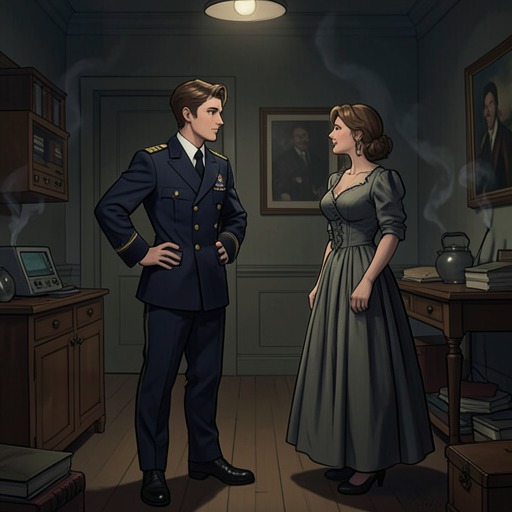
Willie Keith enters the Navy
The Caine MutinyWillie Keith enters the United States Navy only after war moves from distant headlines into his own future. His enlistment redirects a young man who had imagined himself a successful entertainer into officer training and, eventually, the exhausting routines of life aboard the USS Caine. The change is both a personal turn and the gateway to the book’s sustained contrast between Keith’s limited, immediate experience and the immense machinery of the Pacific War.
From nightclub ambition to the draft
On December 7, 1941, Keith secured a better-paid engagement at Club Tahiti, a shabby cellar club on Fifty-second Street. The raise was ten dollars a week, and he emerged pleased with his rise in entertainment. At a newsstand he saw the headline announcing the bombing of Pearl Harbor. He understood that the United States would enter the war, but did not know where Pearl Harbor was and mistakenly placed it on the Pacific side of the Panama Canal. At that moment, the prospect of national war seemed less consequential to him than his new job; his high draft number helped him remain calm.
That evening, Keith raised the possibility of abandoning the piano and his comparative-literature studies to join the Navy, believing he could earn a commission. Mrs. Keith opposed the idea. His sudden success had persuaded her that he might become a celebrated entertainer, and she urged him to pursue that career instead. The exchange captures the imbalance in Keith’s early priorities: military service was imaginable, but still subordinate to professional ambition and the family’s hopes for him.
Acceptance and the last months ashore
Late the following April, a postcard from his draft board invited Keith to a physical examination. The notice brought the war back into immediate view, and he went to a Navy officer-procurement station. He was accepted for the December class of the Reserve Midshipmen School. This route placed him beyond the Army’s reach for the time being and gave him a reprieve before service began; it did not remove him from the war indefinitely.
Mrs. Keith regarded his enlistment as a tragedy. She continued to hope the war would end before he had to put on a uniform and quietly explored whether influential friends could secure him safe duty in the United States. Finding no support for that plan, she tried to make his remaining free months pleasant, taking him on trips to Mexico and Rhode Island. She did not know that May Wynn was part of his life. During the family trips, Keith spent money on calls to the candy store where May worked, and later found excuses to travel to New York to see her. His entry into the Navy therefore followed a period divided between his mother’s attempt to shelter him and his own increasingly serious attachment to May.
The first demands of naval service
Keith’s transition from civilian life to sea duty was materially abrupt. Aboard the USS Caine, he was led to a metal clipping shack measuring roughly seven feet by six by three. Its shelf held empty machine-gun ammunition belts and ammunition cases; a bunk had been welded close to the deck, and Ensign Harding was sleeping there in the heat. The temperature was about 105 degrees. The cramped compartment, initially presented as Keith’s new home, made the conditions of service plain before he had settled into them.
At sea, his days narrowed to watches, coding, correcting publications, bridge duty, hurried meals, and broken sleep. In rough weather he moved repeatedly between the bridge, his communications work, and the clipping shack, rarely sleeping for more than a couple of hours at a time. When the ship at last entered San Francisco Bay, the sudden steadiness of the deck and sight of the Golden Gate Bridge marked a sharp contrast with the rolling, damp passage that had defined his first stretch of duty.
A sailor’s view of the war
By New Year’s Eve, Keith’s view of his decision had darkened. While standing in the cold wheelhouse of the USS Caine, he brooded that he had been foolish to choose the Navy over the Army. He imagined Army soldiers in England enjoying comparatively comfortable surroundings, while Navy crews faced the Pacific’s islands, mines, shore batteries, and aircraft. His expectations were shaped less by strategic knowledge than by the immediate discomfort and danger he feared for himself.
The scale of the war soon appeared around him in forms he could not have grasped from shore. In January, a vast formation of ships sailed from Hawaii toward Kwajalein. The orderly movement of the armada, maintained by officers on watch across the fleet, set Keith’s personal service inside an operation far larger than his own ship. Later, while the USS Caine was at Funafuti Atoll, Keith used a destroyer tender’s communications office to have fleet messages decoded and mimeographed, reducing the burden of the message traffic that weighed on destroyer communicators. His service included such procedural labor as well as the danger he had imagined at sea.
Routine, combat, and limits
The USS Caine’s assignments brought Keith into a grinding cycle of escort duty and paperwork. Days and months blurred into watches, logs, reports, audits, heat, rain, and repeated voyages. The routine was not separate from the war: it was one of the forms through which the fleet moved forces and sustained its operations. Seventeen days before the war ended, the minesweeper finally swept a mine in the China Sea, a concrete encounter with the danger that had figured so prominently in Keith’s early fears.
The ship’s condition also limited what service could offer. After the crew repaired its pumps, Keith and Tom Keefer tried to persuade an officer at the MinePac office that the USS Caine could join the minesweepers preparing to clear Tokyo Harbor. The ship was excluded because it was considered too unreliable for the voyage, especially during typhoon season. Keith’s naval entry had carried him from a New York nightclub to fleet movements and wartime minesweeping, but it did not guarantee participation in every operation. The book also distinguishes this fictional career from historical record: it states that the USS Caine and the events aboard her are imaginary, and that details of actual operations and naval procedures were altered.